

Russia’s financial system is showing another sign of strain.
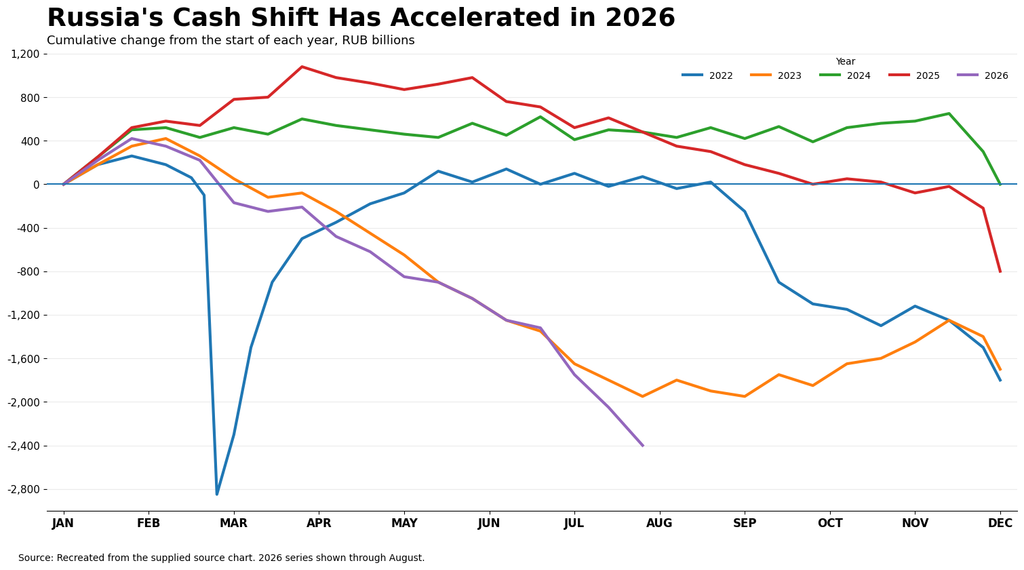
Since the beginning of the year, Russians have moved trillions of rubles into cash, and increasingly draining liquidity from Russia’s banking system. By July, the cumulative increase in cash in circulation since February had reached roughly ₽2.4 trillion.
The pace has accelerated sharply. Cash in circulation increased by roughly ₽480 billion in June, before jumping by more than ₽600 billion in July, according to central bank data. By the beginning of August, Russians held around ₽21.5 trillion in cash, up from ₽18.9 trillion at the beginning of February.
That does not mean Russia is experiencing a conventional bank run. Depositors are not lining up outside branches en masse, and the country’s banking system continues to function. Indeed, the Bank of Russia reported that credit to the economy continued to expand in July.
But the movement matters because Russia’s banks have become increasingly important to the Kremlin’s war.
Since the invasion of Ukraine, Moscow has relied heavily on domestic banks to buy bonds, absorb government debt and help finance an economy increasingly oriented towards war. Every ruble converted from a bank balance into physical cash potentially reduces the pool of liquidity for those functions.
The pressure is already becoming visible. In late July, Sberbank CFO Taras Skvortsov warned that Russian banks had little spare liquidity available to purchase government bonds, linking the shortage partly to roughly ₽2 trillion of cash withdrawals since the beginning of the year.
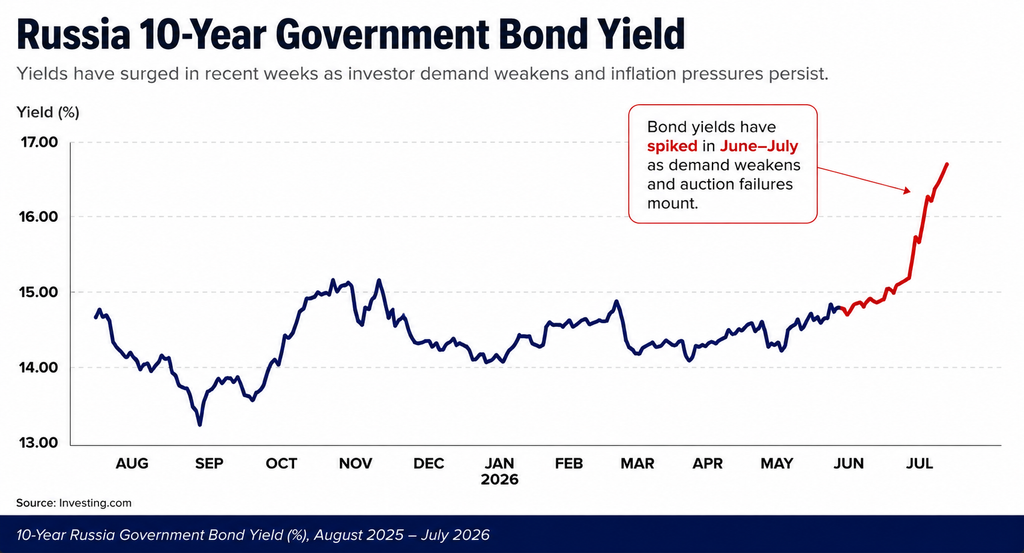
That connects the problem directly to another emerging weakness in Russia’s wartime finances: the government’s increasingly difficult attempts to fund its deficits through the domestic bond market.
Russia may not be facing a bank run. But Russians are taking substantially more cash out of its banks at precisely the moment the Kremlin needs them most.
Why Are Russians Moving To Cash?
There is no single explanation for the sudden demand for physical cash.
One of the most immediate is practical. Russia has experienced intermittent mobile internet shutdowns as authorities attempt to disrupt Ukrainian drone operations, raising fears that card terminals and other electronic payment systems could stop working. The Bank of Russia acknowledged the increase in cash demand in June but said it was providing banks with enough liquidity and saw no need for extraordinary measures.
Tax changes may also be contributing. Russia increased its VAT rate from 20% to 22% at the beginning of 2026, potentially creating a greater incentive for some businesses to shift transactions into cash and outside the formal economy.
But the more concerning explanation is declining confidence.
Years of war, sanctions and government intervention have made Russians increasingly uncertain about the security of their savings. Some depositors reportedly fear that Moscow could eventually restrict or seize private deposits to help finance the war, despite officials denying that such plans exist. Those concerns have been reinforced by the state’s seizure of tens of billions of dollars in private assets and its increasingly aggressive attempts to raise money domestically.
The withdrawals are also becoming increasingly broad. Five of Russia’s seven largest banks reportedly experienced net household deposit outflows during recent months, while Gazprombank lost around 10.8% of its deposits and Rosselkhozbank more than 15% over a four-month period.
None of these factors individually proves Russians have lost faith in their banks.
Together, however, they help explain why households and businesses increasingly appear willing to sacrifice the interest available on bank deposits for something much simpler: cash they can physically control.
Russia’s Banks Have Become Part of the War Machine
The withdrawals matter because Russia’s banks have become an increasingly important source of financing for the war economy.
Since the invasion of Ukraine, the Kremlin has relied on more than direct government spending to expand military production. Russian banks have also channelled enormous amounts of credit towards companies operating in defence-related industries, allowing the state to mobilise resources without placing the entire cost directly on the federal budget.
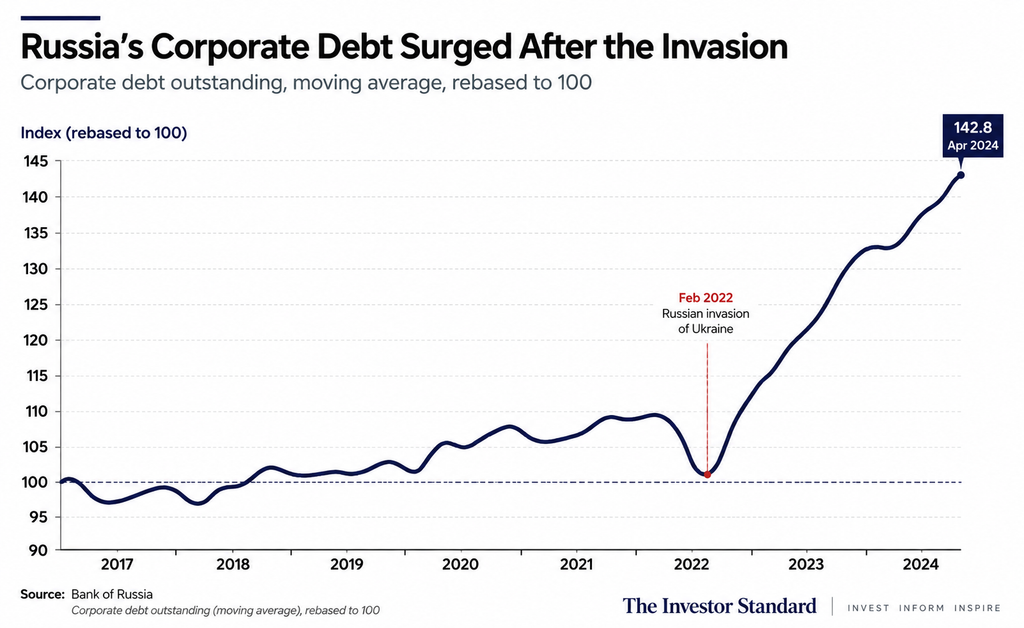
A June report from the Kiel Institute found that Russian corporate debt has risen dramatically since the invasion as banks directed resources towards war-related sectors. The researchers argue that Moscow has increasingly relied on rapid credit expansion and off-budget financing through the banking system to sustain military expenditure.
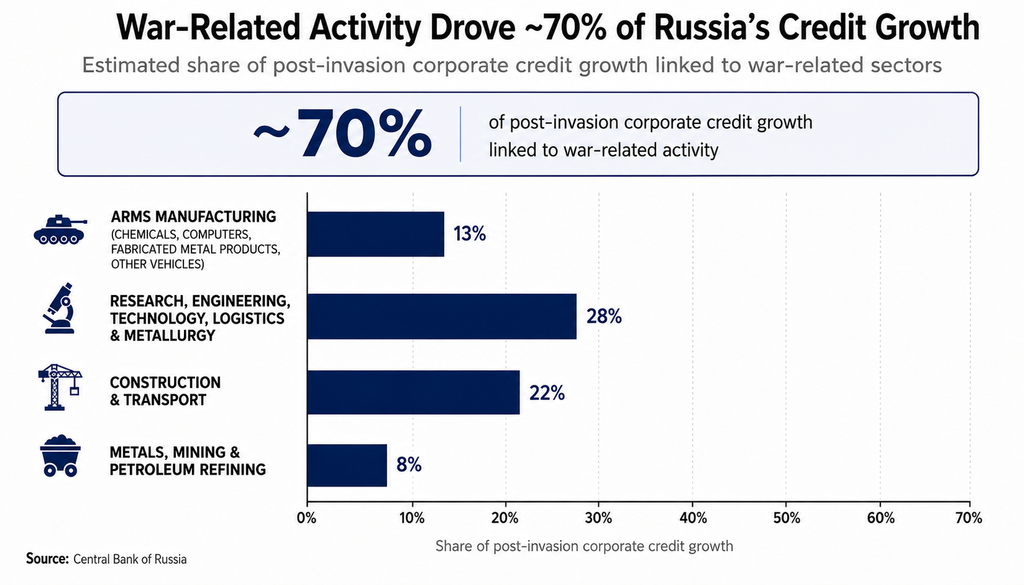
That has helped Russia sustain military production despite sanctions and increasingly stretched government finances. But it has also made the banking system more important to the Kremlin’s broader economic strategy.
Banks need funding to make those loans.
When households and businesses move money from deposits into physical cash, banks lose a source of funding that could otherwise support lending or purchases of government debt. That does not mean every ruble withdrawn translates directly into one less ruble of credit, but persistent outflows can tighten liquidity and make financing more expensive.
The timing is particularly awkward for Moscow. Russia’s liquid sovereign wealth fund assets have fallen from around 6.5% of GDP at the beginning of the war to just 1.8% by April 2026, while its federal budget deficit exceeded the government’s full-year target within the first three months of this year.
The Kremlin therefore increasingly needs its domestic financial system to absorb the cost of the war.
Russians pulling cash from that system makes the job harder.
How Serious Is the Risk?
Despite the scale of the withdrawals, Russia is not yet experiencing a conventional banking crisis.
The banking system remains profitable, lending continues to expand and household deposits actually increased 0.3% in July, even as demand for physical cash remained elevated. Corporate lending accelerated to 1.5% monthly growth, while the sector generated ₽443 billion in profit during the month.
The Bank of Russia also retains considerable capacity to provide liquidity if individual institutions come under pressure. That matters because cash withdrawals become dangerous when banks cannot replace the funding leaving the system.
There are signs, however, that liquidity is becoming tighter. Bank of Russia data showed the banking system running a liquidity deficit of roughly ₽2.5 trillion on 25 August, meaning banks were reliant on central-bank funding to bridge the gap between available and required reserves.
That makes the distinction important. Russia does not appear to be experiencing a 1991-style rush to empty bank accounts, and continued deposit growth makes describing the current situation as a nationwide bank run misleading.
Instead, the risk is one of gradual financial pressure.
Russian banks are being asked simultaneously to finance businesses, support defence-related industries and absorb government borrowing while households increasingly prefer to hold physical cash.
The system can continue functioning under those conditions. It simply becomes more dependent on the central bank to do so.