

Nvidia has spent the past several years selling the infrastructure behind the artificial intelligence boom. Increasingly, however, it is doing something else: helping finance the customers buying it.
The chipmaker has invested nearly US$50 billion in frontier AI laboratories, provided credit support to emerging cloud companies and supported arrangements to finance the acceleration of construction of enormous new data centres. It is also working with 6 major Wall Street firms on an initiative targeting as much as US$500 billion in financing for chip purchases.
Perhaps nowhere is that strategy more apparent than in Ohio, where Nvidia has agreed to provide financial support for a planned 10-gigawatt data-centre campus involving OpenAI and SB Energy.
Nvidia could backstop as much as US$105 billion of the project’s completed value while securing the exclusive right to supply chips for its first half. OpenAI’s chip purchases across the completed development are expected to total roughly US$350 billion.
The arrangement creates an unusual financial loop.
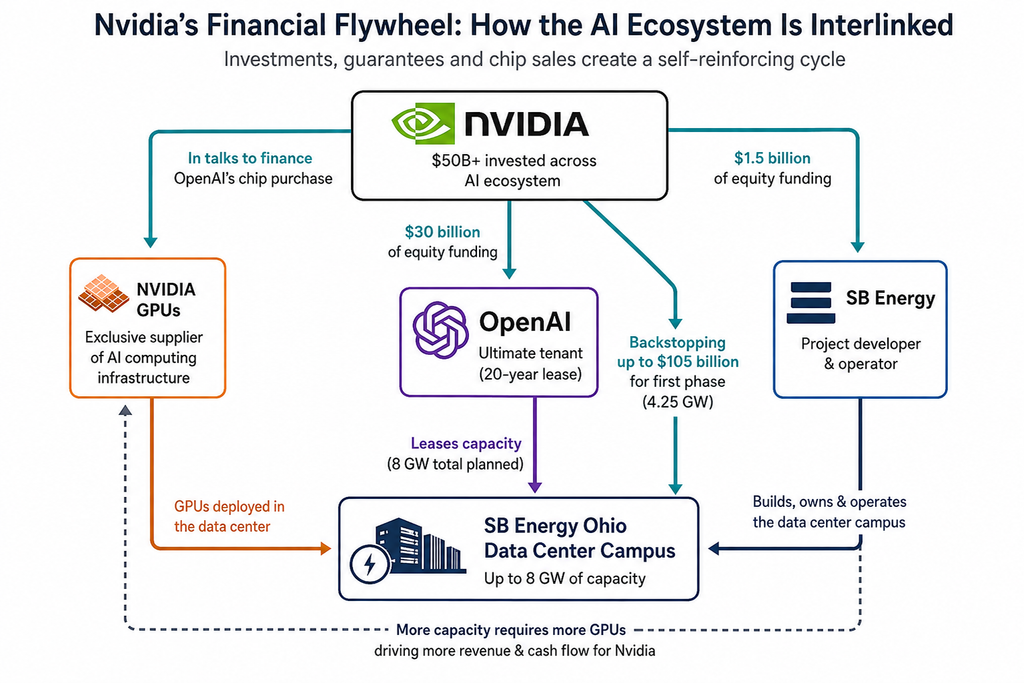
Nvidia helps provide the capital required to build AI infrastructure. That infrastructure allows companies such as OpenAI to deploy more computing capacity. Much of that capacity is built using Nvidia GPUs, generating additional revenue and cash for Nvidia—which can then be deployed to support still more AI infrastructure.
Critics have an obvious description for this: circular financing.
Nvidia prefers another.
“Nvidia is needed to help power this flywheel,” CFO Colette Kress told investors this week.
And with Nvidia now valued at around US$5 trillion, the distinction between a flywheel and a circle is becoming one of the most important questions surrounding the AI boom.
Nvidia’s New Financial Machine
Nvidia’s role in the AI boom is expanding beyond designing and selling GPUs.
The company is increasingly deploying its balance sheet across the infrastructure required to keep demand for those chips growing. That includes guaranteeing credit, financing support and direct equity investments in companies building the power and data-centre capacity AI needs.
The scale is already substantial.
Nvidia CFO Colette Kress says the company has invested nearly US$50 billion in frontier AI laboratories. Nvidia is also working with major investment firms on an initiative targeting US$500 billion of financing for chip purchases, while providing credit enhancements to AI laboratories and emerging cloud providers that may otherwise struggle to borrow enough to fund their expansion.
The strategy now extends beyond Nvidia’s direct customers.
Earlier this year, Nvidia invested US$2 billion in power developer Lancium, acquiring a 20% stake with the option to invest another US$1 billion. It has since invested hundreds of millions in Cloverleaf Infrastructure and committed an initial US$1.5 billion to SB Energy, the developer behind the enormous Ohio data-centre project.
The logic is straightforward. Every new power project can support additional data-centre capacity. Every new data centre can house more computing infrastructure. And much of that infrastructure ultimately requires Nvidia GPUs.
That means Nvidia is no longer waiting for the AI ecosystem to develop around its products.
It’s using the extraordinary profits generated by the AI boom to accelerate the construction of the ecosystem that will generate its future profit, cash flows and sales.
For now, the strategy appears financially manageable. Nvidia’s rapidly expanding revenue and cash generation give it resources few companies can match.
But the growing connection between Nvidia’s financing activities and its customers’ ability to purchase Nvidia products raises a more complicated question.
Where does supporting demand end and financing your own sales begin?
The Ohio Deal Shows How Far This Can Go
The clearest example of Nvidia’s strategy is a planned data-centre campus in Pike County, Ohio.
SB Energy will build, own and operate the facility under a 20-year lease to OpenAI, with the project ultimately expected to provide 8 gigawatts of computing capacity. Nvidia will be the exclusive provider of AI computing infrastructure at the site.
But Nvidia is not simply supplying the chips.
The company has agreed to provide credit support for the land, power and construction required for the initial 4.25 gigawatts of capacity, with guarantees potentially reaching US$105 billion. Nvidia is also investing US$1.5 billion directly into SB Energy, the company developing the campus.
The result is an unusual arrangement.
Nvidia helps finance the developer. The developer builds a data centre for OpenAI. OpenAI leases the capacity. The data centre runs exclusively on NVIDIA computing infrastructure.
Nvidia argues that this is not circular financing. OpenAI remains responsible for paying its lease, while Nvidia says it is simply using its balance sheet to overcome the enormous financing and infrastructure bottlenecks preventing AI capacity from being built quickly enough.
There is considerable logic to that argument.
If OpenAI already has sufficient underlying demand for additional computing power, Nvidia’s support simply allows infrastructure that would eventually have been built anyway to arrive sooner.
But it also creates an increasingly important relationship between Nvidia’s financing activities and its own future revenue.
The company selling the infrastructure is now helping provide the financial support required to build the facilities that will purchase that infrastructure.
And that is where the distinction between Nvidia’s “flywheel” and circular financing becomes much harder to define.
Is This Actually Circular Financing?
The answer depends on what Nvidia’s financial support is actually doing.
Vendor financing itself is nothing unusual. Companies have long provided loans, guarantees or favourable financing terms to help customers purchase expensive products. Aircraft manufacturers, industrial equipment companies and technology vendors have all used similar arrangements when customers face large upfront costs.
The concern arises when financing starts to shape the demand that the company reports.
If an AI company already intends to deploy billions of dollars of Nvidia GPUs and Nvidia simply helps lower the cost of financing the necessary infrastructure, the arrangement looks relatively straightforward. Nvidia is accelerating demand that already exists.
But if customers can only afford increasingly large purchases because Nvidia is investing in them, guaranteeing their financing or supporting the infrastructure they require, the distinction becomes less clear.
That does not make Nvidia’s revenue artificial. Its customers still receive real chips, data centres are actually being built and Nvidia still earns revenue from products that are being deployed.
The question is instead whether the extraordinary pace of AI infrastructure spending could be sustained without Nvidia’s balance sheet helping support it.
That matters because Nvidia increasingly has exposure on both sides of the AI boom.
It benefits when customers spend more on computing infrastructure, while simultaneously investing capital and assuming financial risk to help those customers spend more.
For as long as AI demand continues growing rapidly, the distinction may seem largely academic.
But if that growth begins to slow, the difference between a self-reinforcing flywheel and a financially dependent circle could become considerably more important.
Why Nvidia Thinks the Flywheel Works
From Nvidia’s perspective, the problem is not a lack of demand for artificial intelligence. It is that the companies generating that demand cannot build infrastructure quickly enough.
Frontier AI laboratories such as OpenAI and Anthropic are growing far faster than their balance sheets and credit profiles would ordinarily allow. Training and operating increasingly powerful models requires enormous quantities of computing capacity, but financing the data centres, power generation and chips needed to provide it can require hundreds of billions of dollars upfront.
Nvidia has something its customers often do not: an extraordinarily powerful balance sheet.
The company therefore argues that using some of that financial capacity to remove bottlenecks is simply rational capital allocation. If Nvidia can guarantee financing, invest in a power developer or support a data-centre project that would otherwise take years longer to build, it can accelerate the deployment of infrastructure for which underlying demand already exists.
And Nvidia may not need to play this role forever.
As frontier AI companies mature, their ability to access conventional capital markets should improve. An eventual OpenAI or Anthropic listing, for example, could give those companies much greater capacity to raise equity and issue debt independently.
Under that interpretation, Nvidia is not permanently financing its customers.
It is bridging the gap between the enormous demand for AI computing today and the financial capacity of the companies trying to provide it.
If Nvidia is right, the strategy could be enormously profitable.
But it also means the company is making a very large bet that the demand it is accelerating eventually becomes capable of financing itself.
What Happens If the Flywheel Slows?
For now, Nvidia’s strategy is being supported by extraordinary growth.
As long as demand for AI computing continues rising, customers need more chips, developers need more data centres and power companies need more generation capacity. Nvidia can use the cash produced by one part of that expansion to accelerate the next.
The risk is what happens if the economics of AI begin to disappoint.
Nvidia is increasingly exposed not only to the companies buying its chips, but also to the broader ecosystem enabling those purchases. It owns stakes in frontier AI labs, invests in power and data-centre developers, provides credit support and has assumed potentially enormous financial guarantees.
A slowdown could therefore affect Nvidia in several ways at once.
Customers could reduce orders for new GPUs. Investments in AI companies and infrastructure developers could lose value. Projects supported by Nvidia guarantees could become more difficult to finance. And companies that previously relied on Nvidia’s balance sheet could require even greater support just as Nvidia became less willing to provide it.
That does not mean the strategy is destined to fail.
If AI revenues eventually justify the hundreds of billions being invested in infrastructure, Nvidia may have done something remarkably effective: used its balance sheet to remove the constraints preventing its largest future market from developing faster.
But the strategy also changes the nature of the bet investors are making.
Nvidia is no longer simply selling chips into the AI boom. It is increasingly helping finance the boom itself.
Nvidia calls that a flywheel. Critics call it circular financing. The difference may ultimately come down to a much simpler question:
Is Nvidia financing demand that already exists or helping create demand that depends on Nvidia’s financing to exist at all?